
Finding remote work now isn’t as easy as it was during the pandemic and the immediate years after. Think 2020–2022. High competition, an increasing number of remote applicants, layoffs, and return to office (RTO) policies are some of the reasons causing the struggle.
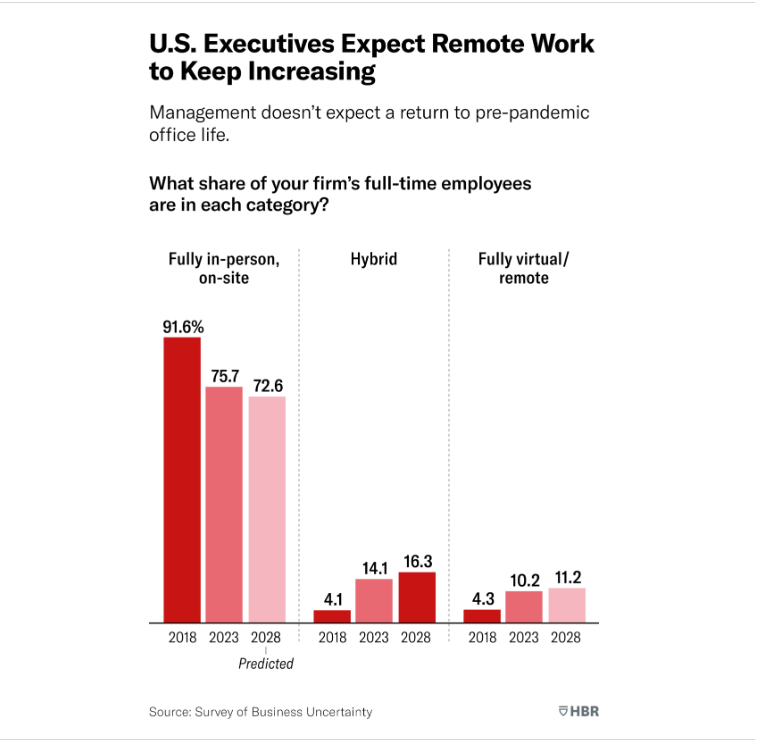
But this doesn’t mean you cannot land remote jobs. Remote-first companies still exist and so does remote hiring. According to a 2023 survey by Harvard Business Review (HBR), remote work isn’t going anywhere and executives know it.
Executives in the survey predicted that fully in-person on-site employees were going to reduce from 75.7% in 2023 to 72.6% in 2028; hybrid will increase from 14.1% in 2023 to 16.3% in 2028; and remote work will increase from 10.2% in 2023 to 11.2% in 2028. The gap is not huge, but there is still a slight increase — which counts.
Therefore, you can find remote work. It will, however, require a lot more effort and time investment.
Learn how to find remote work based on the tips below. You’ll also get a list of sites to explore — to answer your question, “Where can I find remote work?”
6 Tips to Consider Before Looking for Remote Work
Know why you want a remote job
Knowing your “why” will help you find opportunities that fit what you’re looking for. Without a why, you’ll jump on any opportunity even if it’s not a great fit and you might end up hating your job. So search with purpose. Identify why you want what you want and let that guide your remote job search.
Understand remote work terminology
Learning the different names for remote work, the various forms of remote work, and generally understanding the remote work landscape will do you a lot of good. It’ll help you understand what to search for, how to search for it, and even guide you to look in the right places.
- Did you know there are 17 different ways to say remote work?
- Do you understand what fully remote and hybrid mean?
- What about full-time employee and contractor?
- What does Remote, US or Remote, UK mean?
Etc
Having answers to these questions will help you apply for jobs you’re only eligible for.
To get answers to the above questions. Search Google or use AI tools like Gemini, Microsoft Copilot, and ChatGPT. Copy all the questions and use this prompt: Answer these questions or Kindly give me answers to these questions
Explore alternative job titles
Focusing on one job title only will likely limit your search. This is because different companies have different job titles for the same function. So it’s great to have a list of related job titles to consider and base your job search on those.
This doesn’t mean you’re applying for completely different roles. Same roles and responsibilities but different job titles.
Again, AI can give you a list of alternative job titles for your target role
Prompt: Generate a list of alternative or related job titles for {Name of Primary Job Title}
“Read to understand” job descriptions
Don’t just read what you think is important in the job description. Whether it’s about the company, compensation, requirements, responsibilities, etc — read everything!
Develop a habit of reading job descriptions as many times as you need to and ensure you not only fit the bill for the company, but the company also fits yours.
Remember your “why”; why you want a remote job. The job description and other information you’ll find about the company should at least convey some of that — even if not all.
Learn how to search for remote jobs
Be it using job boards, scouting company career pages, using Google search, etc. It’s good to learn how to look for remote jobs well.
One effective way is to employ Boolean search operators to conduct precise job searches — mostly on Google, LinkedIn, and job sites. This will help limit, widen, or define your job search.
Learn more about Boolean search and how to use it here →
Reverse engineer what you learn in the last article for job searching.
Don’t limit yourself to only remote job boards
The first thing you’d usually consider when looking for remote work is to check remote job boards.
Don’t get me wrong. Job boards are great. They help you find some jobs.
But it doesn’t mean you shouldn’t try other means of finding remote work. You can find jobs on company websites, search engines, online communities, within your network, etc.
These other alternatives can increase the number of tailored roles you find.
Keep a document to identify and track companies and roles
Document your job search. Always.
Once you find companies and roles you like, write them somewhere, this will help you keep track of your search and give you a directory of roles and companies you can always refer back to in the future.
You can use spreadsheets like Google Sheets or Microsoft Excel to create one. Alternatively, use application tracking tools like Teal to save jobs.
Pro-Tip
If you did not find the job advert directly on the company website, always confirm on the company website and apply directly on the listing available on their site — if they have a careers page.
Notes: This isn’t a step-by-step guide on how to find remote work opportunities because there’s no one-size-fits-all approach. The most important thing is to know what you want, why you want it, how you can find it, and where you can find it.
In the next section, you’ll learn other parts of how to find remote work based on specific use cases of the best ways (and places) to find remote work.
Where Can I Find Remote Work?
Now that you’ve equipped yourself with the tips and best practices, let’s help you with the best places to find remote work.
Job boards
For most people in emerging markets like Africa, job boards aren’t always a good option for them because they’re filled with remote opportunities for people in the Americas, Europe, UK, etc.
However, new job boards are emerging to ensure inclusivity and accessibility to remote opportunities. Find below a list of job boards with remote opportunities from companies hiring across the globe:
- InclusivelyRemote
- Jobgether
- AfriSplash Remotely
- Himalayas
- We Are Distributed
- Wellfound (formerly AngeList)
- RemoteAfrica
- We Work Remotely
- Jobspresso
- Remotive
- Remote.co
- Teal
Company websites
Another great place to find remote work is company websites. These also help you find legitimately available roles. Here’s a list of companies that hire remotely worldwide:
- Deel
- Doist
- Veed
- Float
- Buffer
- Finixio
- InEvent
- Remote
- Binance
- Uscreen
- Appcues
- Canonical
- Oyster HR
- Consensys
- Customer. io
- Scopic Software
- Awesome Motive
Pro-tip: Set notifications and keep your eyes on their Careers pages. For companies like Finixio, you sign up to receive new job listings.
Freelance online marketplaces
Everyone can use online marketplaces. But if you’re starting out and finding it difficult to land full-time roles, these platforms are great for securing clients on a contract basis as a freelancer. You may eventually get full-time and permanent roles with some clients you work with.
Social media posts
There are social media accounts on Twitter and LinkedIn that frequently share job openings. Additionally, companies list open roles on their websites but recruiters, hiring managers, and sometimes Founders also go a step further to announce it on socials.
So searching for roles on social media platforms is great! Use the search boxes using Boolean searches or create a post announcing your job search so people can tag you in opportunities.
Here are 2 accounts that occasionally share great job opportunities:
Word of mouth/ your network
Letting people know you’re open to work makes it easier for them to bring relevant opportunities your way.
For LinkedIn, you can use the “Open to Work” frame and also make a post. For platforms like Twitter, making a post may be great.
Additionally, inform your friends, family, and community about your job search so that when they come across job openings that might be a great fit for you, they can share them with you.
Connect and reach out directly to recruiters
This is one of the best ways to find remote work. A part of a recruiter’s work is to proactively source candidates for roles within the companies they work with. So while you’re looking for companies to work with, they’re also looking for candidates to fill those roles within their companies.
Therefore, it’s great to find them and connect with them. Or make it easier for them to find you and share open remote opportunities with you.
How do you do this?
Optimise your LinkedIn profile. Then go on and find recruiters and connect with them. They’ll also find you if you have the relevant keywords in your profile, which will cause you to appear in their searches.
Here’s a thread of threads to get you started:
Online communities
Industry communities are a great place to find open remote opportunities. Some communities have dedicated job boards/channels in the community, while others randomly share job listings. Here’s a list of communities for NoCode Techies that you can explore.
Use ATS sites
Applicant Tracking Systems (ATS) are software tools used by HR and recruiting teams to manage job postings, applications, candidate information, and communications throughout the recruitment process.
Examples include BambooHR, Greenhouse, Lever, Workable, and BreezyHR
The good news for job seekers: you can easily find roles listed on these ATS sites.
Read this article by Robert Gibb to learn how to find hidden remote jobs on these sites — using Google
Wrapping Up
Finding remote work is quite difficult now. It may take longer than expected and can be extremely draining. Remember to always give yourself some grace during your job search process. You’ve got this!
Recommended Reading: How to Build Resilience and Overcome Rejections During Your Job Search

 NoCode Techies