

The Ultimate Networking Guide For Job Seekers and Non-Coders Transitioning into Tech
It’s important to build your network — connect with people and establish mutually beneficial professional relationships. But it’s even more crucial when you’re transitioning into tech or remote job searching.
This is because you may not get access to some job opportunities, resources, and people — in public. Some of these things will be privately shared with you through your network. That’s why you must be intentional about building and nurturing these relationships. And in this guide, I share steps, best practices, and tips to help you build or expand your network.
Let’s start with the basics.
What is a Network?
According to Computer Hope (2023), a network is “a system that allows two or more devices to exchange information, resources, and services”.
Don’t stop reading just yet. We’re not here to talk about computer networks but this definition is true when you translate it to social and professional settings; only that human beings are the “devices” this time.
Your network links or connects you with others, enabling you to exchange resources, information, opportunities, support, and more! This network can be social (friends, family) or professional (work colleagues, schoolmates, mentors, coaches, industry leaders).
Networking is the act. It means building mutually beneficial relationships and making connections with people in a professional capacity. It is when you actively invest time and energy to add another human into your collection of people you know and interact with — for one reason or another.
It’s worth noting that networking is not only something you do with seniors, superiors, or people at higher heights than you. Your network could be your classmates, churchmates, etc. Everyone has value as a network.
Why is it Important to Build Your Professional Network?
There are so many reasons why networking matters, especially when you’re job hunting or breaking into a new field.
1. You don’t know what you don’t know: This is very easy to believe and understand, but what does it mean? It means your network can be your source of exposure to new opportunities and knowledge, as well as information about what is happening in the work world.
2. Word of mouth is the best form of marketing: Think of your network as your “Uber reviews”. The more people review you positively, the more opportunities will come your way.
3. You get access to support and guidance: Your network can be a source of invaluable support and guidance throughout your career. For instance, when you join industry communities to network, you can easily connect with leaders and peers and ask questions.
4. Not every job is advertised publicly: Often, companies rely on referrals from their network to fill positions. Having a strong network increases your chances of hearing about unadvertised opportunities that could be a great fit for you. You may even secure a referral which can increase your chances of landing the role.
How to Build Your Network
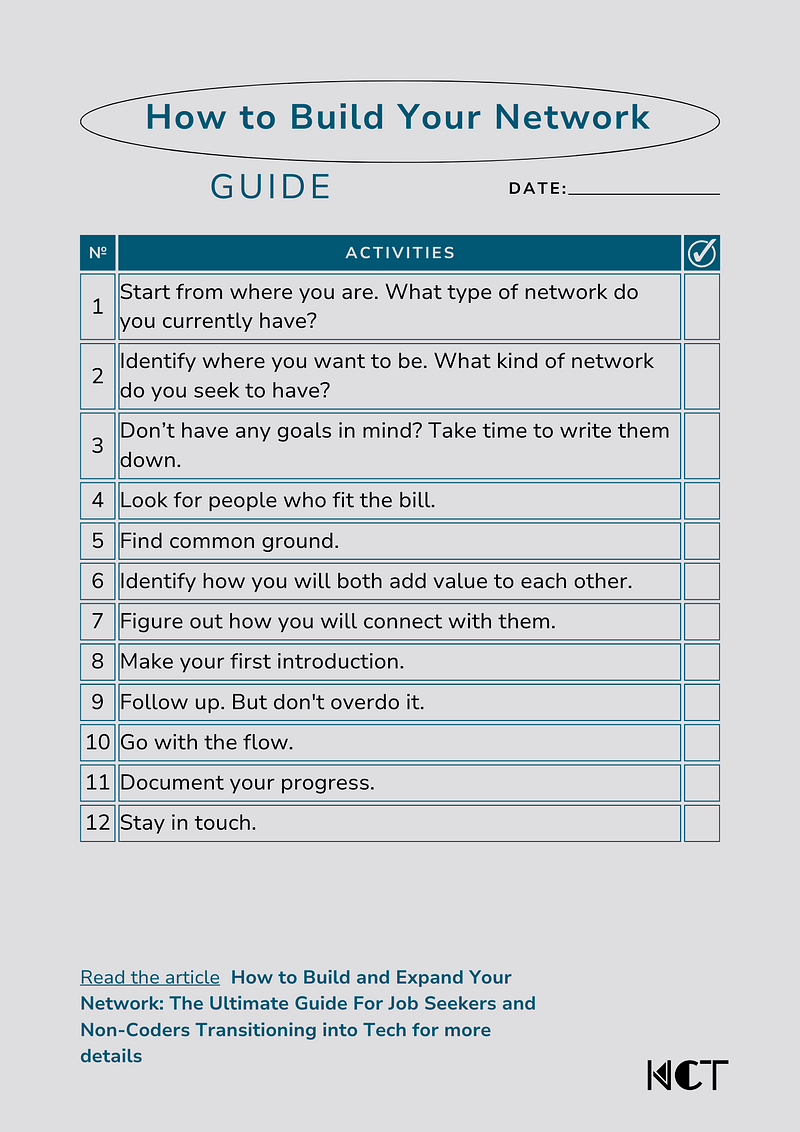
Is there a one-size-fits-all approach to networking? Absolutely not! But there are common elements that run through almost every networking piece of advice you will receive from experts. We’ve compiled them and created this simple guide to get you started and going with networking.
1. Start from where you are. What type of network do you currently have? Which people do you have in your network? Find answers and write them down.
2. Identify where you want to be. What kind of network do you seek to have? Which people should be in that network? How will they get you closer to your goals?
3. Don’t have any goals in mind? Take time to write them down. It could be to help you land a job, better understand the industry, meet new people, etc. Always network with a goal in mind.
4. Look for people who fit the bill. Once you know what you want and how you want your network to look like, look for people who meet your criteria and can help you get a step closer to where you want to be.
5. Find common ground. Finding the people is one thing. But knowing them, understanding who they are, and identifying common ground is paramount. This is because people are most likely to connect with people they have something in common with. Plus, this will help you connect in a way that shows that you did your homework and are interested in them.
6. Identify how you will both add value to each other. Networking is a two-way street. Though you need something, you must figure out how you’ll add value to the person on the other end. How can you ensure they benefit from the relationship you’re trying to build? It doesn’t have to be big. And there’s always something to offer. That’s why reading about them is important.
7. Figure out how you will connect with them. Will you reach out to them directly? Or do you need a third party, possibly a mutual friend to do the introduction? Whichever you decide to go with, be ready for it.
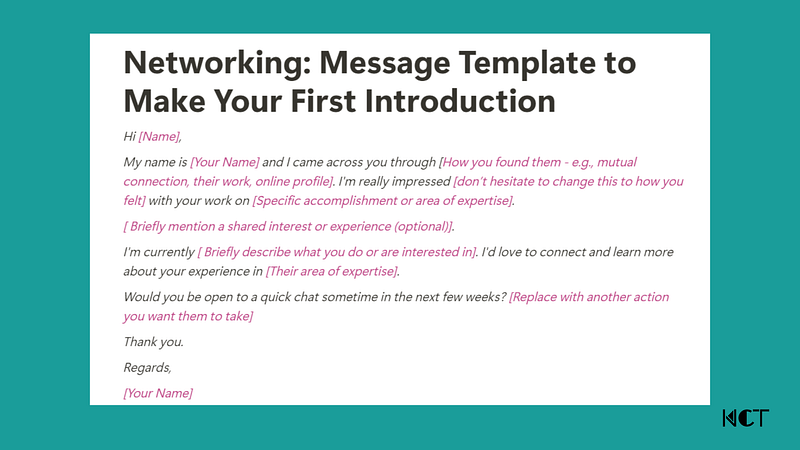
8. Make your first introduction. If you’re doing a self-introduction, craft a well-thought-out and personalised message or email and deliver it through your preferred platform. Remember all the research you did. Use that information in your introductory message. If someone is doing the introduction for you, clearly spell out what you want them to do. Make it easier for them to introduce you. Lastly, keep the message brief. Try not to go over 100 words. Here’s a template:
9. Follow up. One message may not suffice. You may not get a response on your first outreach. And you will have to follow up about 2–4 times to push your messages up. But leave gap spaces (3–4 days intervals) in your outreach to avoid being seen as pushy or annoying.
10. Go with the flow. Once you’re in, you can go with the flow. There’s no formula for dealing with people. Just make sure you understand the terms of your relationship, are not crossing any boundaries, and are putting in the work. The rest is up to you.
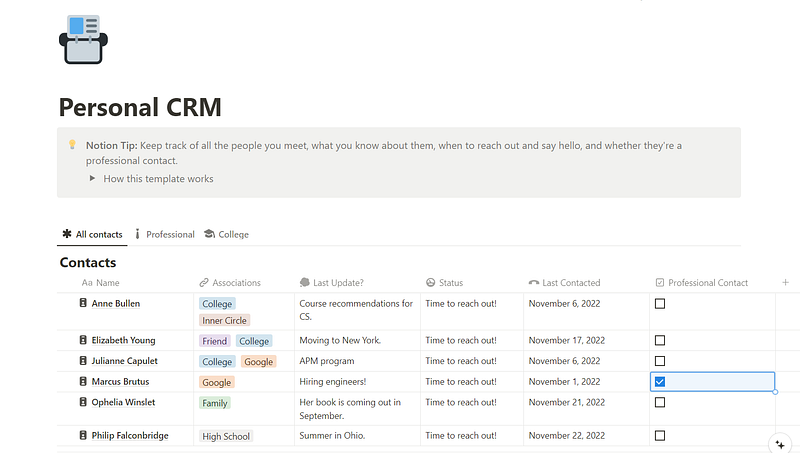
11. Document your progress. You might want to keep things organised by documenting your progress or tracking the people you’ve connected with. A simple spreadsheet will do. You can also use Notion’s personal CRM or your notes app.
12. Stay in touch. Networking is not a one-time thing. It is a continuous process. And you don’t only want to reach out when you need something. Stay in touch and share relevant information or add value whenever you can.
Remember, you’re dealing with humans, not robots. So be human. Be conversational.
Where Can You Meet People to Add to Your Network?
Online communities
This might be the best place to start if you’re unsure where to start. With industry communities, you’ll get access to leaders, peers, tools, and resources, among others — in one place.
Additionally, most online communities have job boards so you’ll get access to open job opportunities and may even directly connect with hiring managers and recruiters. You might also meet your mentor or career coach in these communities.
Check out this curated list of industry communities →
Social media
LinkedIn literally has a connections feature. And while everyone you connect with is a connection, you can be more intentional about this to ensure you build actual connections.
Without a LinkedIn premium account, sending personalized invites is limited so you can connect first and then introduce yourself after they accept your invitation. Another good option is to engage their posts frequently. Not just likes. Leave a comment, repost, etc.
Apart from LinkedIn, you can also network on Twitter. It’s hard to send direct messages without premium accounts or verified accounts. So your best bet is to engage them on the timeline, just like LinkedIn.
Mind you, industry professionals are more likely to follow you on LinkedIn than they will on Twitter. Also, don’t give up on engaging their posts. Trust me, they will notice you.
Industry events
Attend industry events, contribute, ask questions, talk to people. This is how you get noticed. Do this for both online and in-person events you attend.
It may be different for virtual events considering you may be unable to talk to people. But usually, in virtual events, the moderators give opportunities to follow speakers and attendees on socials. So participate in these activities and start engaging them.
Work/School
Some of your work and schoolmates can be good additions to your network. And even at work, your managers and executives may also be good fits depending on the relationship you seek to build with them outside of work.
Networking Tips and Best Practices
1. If you’re an extrovert, be everywhere. If you’re an introvert be in as many places as you can. One thing you can never replace is socialising with people as a way to build your network. To meet more people you need to be in more places — community chats, workshops, conferences etc.
2. Establish and maintain real connections. Nobody wants to be used, so it doesn’t work in your favour to only reach out to people when you need something.
3. Find people at the company you’re applying to and connect with them. This is truly helpful if you don’t know who to network with.
4. No LinkedIn Premium subscription? Do this. Engage with the posts of the people you want to connect with. Getting the attention of those 2nd and 3rd-degree connections requires creative solutions, but they have been known to work! See below exhibit A.

5. Consider the quality of the network you’re trying to build. Remember your networking goals. These goals will help set a benchmark for the people you’ll need in your network. Make sure you’re not just talking to people for the sake of it. Connect with the right people to build a high-quality network.
6. Ask for help. It may not seem like it, but asking for help is a sure way to network. When you ask for help, your contact person may either give you the solution or refer you to someone who may be better at what you need. From there, you can build a mutually beneficial relationship and nurture it.

 NoCode Techies