
The job search process is daunting and full of ups and downs, so reaching the interview stage is a significant achievement. Many companies have various types of interviews and stages before deciding on a candidate, which you can’t control. However, you can control how well you prepare for these interviews.
This article will equip you with the tips and tools to ace your interviews and land your dream job.
How to Prepare for the Interview
Refresh your memory about the company and role
Before applying for the job, you must have already conducted initial research about the company, so revisit your notes and do additional research if necessary. This will help you stay abreast with their mission, values, recent news, etc.
Once done, review the job description multiple times to ensure you understand the requirements, the reasons for hiring, and what is expected of you. When you do this, you’ll be able to tailor your experiences to fit the description the company is looking for.
💡 Always document your findings at the beginning of your application process to save time when preparing for interviews.
Review your application documents
The responses you provided in your application form will be referenced during your interview. Therefore, review all your application documents — resumes, cover letters, portfolios, etc — to ensure you can confidently discuss the information you submitted.
Practise common interview questions
Certain interview questions are almost always asked, regardless of the company or role. Examples include: “Tell me about yourself”, “What are your strengths and weaknesses?” and “Why are you interested in this role?”
Your job here is to make a list of these common questions and others typically asked in interviews, then write and practice your answers. You’ll find a list of 60+ common interview questions and answers here.
💡 Use the STAR method (Situation, Task, Action, Result) to clearly articulate what you have done, how you did it, and the results you achieved. To leave a lasting impression, tell stories that connect with the interviewer.
Prepare your questions
One question you’ll almost always encounter is, “Do you have any questions for us/me?” You might be tempted to say no to let your interviewers go, but this could reduce your interview score and work against you in the long run. Also, asking questions shows that you are proactive, have done your homework, and are genuinely interested in the position and the company.
So just as you prepare answers for likely interview questions, you should also prepare thoughtful questions to ask the interviewer or team. Research and document a list of relevant questions about the company, role, department, etc. Find a list of 38 smart questions here and here.
Conduct mock interviews
Whether you’re preparing for an in-person or online interview, conducting mock interviews in a similar environment can be very beneficial. This practice helps you articulate your thoughts and responses in a realistic setting.
To do this, find someone to act as the interviewer and ask you questions as if it were a real interview. Provide them with all the details and questions you’ve gathered to make the mock interview as effective as possible.
Consider the technicalities (for remote interviews)
Unlike in-person interviews, remote interviews require you to ensure you have a reliable internet connection, a quiet workspace, good lighting, and a personal computer or mobile phone (in rare cases) to ensure a smooth interview process.
Additionally, it’s good to have a backup plan in case things go south. Some people have missed interview opportunities and lost jobs because their internet or power went out.
Connect with an insider
Try to connect with an employee or someone in your prospective department within the company to learn about the interview process and what to expect and also to find out if the company is still a good fit for you.
If you connected with someone while applying for the role, don’t hesitate to reach out to them again.
8 Tips for a Successful Job Interview
This section includes tips on what to do on the day of and during the interview.
Practice one more time before the interview
The goal is not to memorise and recite your answers verbatim. Instead, read through your notes and answers to keep the main points top of mind.
Dress appropriately
Yes, appropriately, not necessarily professionally. The format of your interview — whether in-person or online — will determine how you should dress.
For in-person interviews, dressing professionally is usually the best approach. However, for online interviews, your attire can range from formal to casual, depending on the company’s culture and the role you’re applying for.
Dressing well has a way of boosting your confidence because it helps you feel more prepared and presentable.
Take along any relevant documents (for in-person interviews)
You won’t need this for virtual interviews, but for in-person interviews, it’s essential to bring a file containing relevant documents like your resume, cover letter, and portfolio. There may also be other important documents required by the company, which will be mentioned if necessary.
Arrive early
To avoid rushing and feeling flustered before your interview, it’s important to arrive early. Arriving early will also give you time to practice pre-interview anxiety techniques, such as deep breathing, to calm your nerves.
Furthermore, for online interviews, arriving early also allows you to test your internet connection, camera, lighting, etc., before the interview begins. This gives you enough time to settle in and find a good position.
So, how early should you arrive? For online interviews, aim to be ready 10–15 minutes before the scheduled time. For in-person interviews, arrive 15–30 minutes early.
Pay attention to your body language
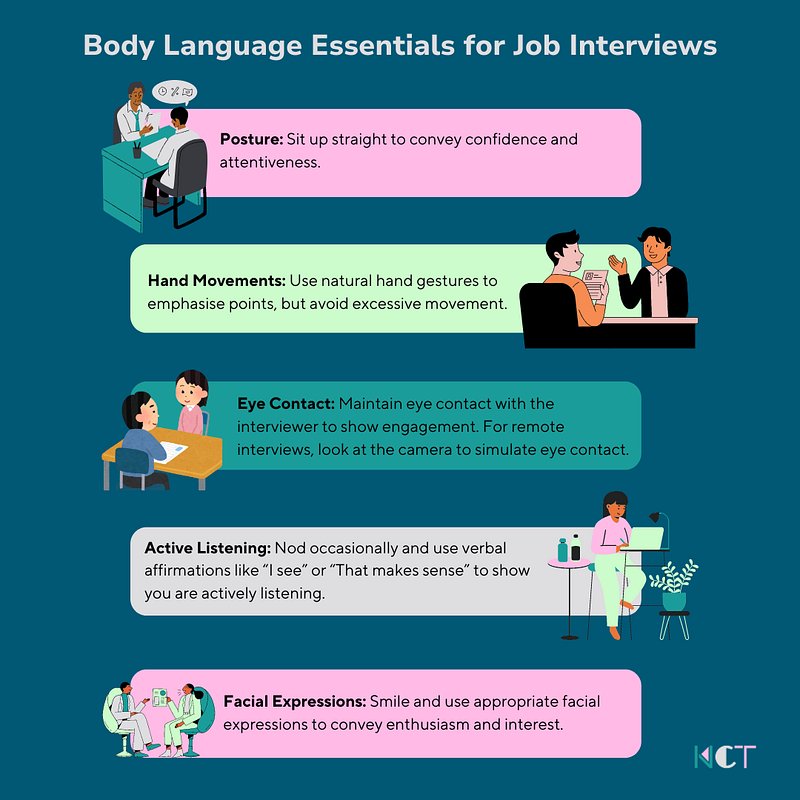
In interviews, nonverbal communication is just as important as verbal communication. The way you sit, move your hands, maintain eye contact (or camera contact), and actively listen all play significant roles.
Learn how to answer questions
Answering interview questions effectively can significantly increase your chances of getting hired. There’s a saying that the most qualified candidate isn’t always the one who gets hired, but rather the candidate who knows how to sell themselves well.
So you need to know how to sell yourself. Show the company what you can offer, how you plan to help them solve their problems, and why they should hire you.

After the Interview, What Next?
Send a thank you email to the interview panel, individually
After the interview, draft a thank you note to the interviewers. This keeps you top of mind and shows that you are genuinely keen on working with the company. Express your enthusiasm for the role and include a line or two about why you think you and the company are a great fit for each other. You can also reference something from the interview to create a connection with the interviewer over email.
Follow up
You may not always get a response about the status of your application. Sometimes you’ll receive it later than expected, and other times, you might be ghosted. If a specific time frame for feedback was given, wait until that time has passed before sending a follow-up email. If no date was provided, wait a week or two before following up on your application.
Do not bombard the hiring team with too many follow-up emails. Just one or two will suffice.
Common Interview Concerns and How to Deal with Them
Handling difficult questions
You may not have answers to every question you’re asked during an interview, but you need to find your way around them. Here are some strategies to help you deal with challenging or unexpected questions:
- Stay calm and focused: Take a deep breath and maintain your composure.
- Ask for clarification: If a question is unclear, ask for more details to buy some time and better understand what is being asked.
- Think aloud: If you’re unsure, think aloud to show your thought process. This can demonstrate problem-solving skills.
- Admit when you don’t know: If you genuinely don’t know the answer, admit it honestly and express your willingness to find out.
- Relate to similar experiences: If you don’t have a direct answer, relate the question to a similar experience or skill you possess.
Combating Imposter Syndrome
Imposter syndrome is a common feeling of self-doubt and inadequacy. It can make you feel like you don’t deserve your achievements or that you’re not as competent as others perceive you to be. Here’s how to deal with it:
- Acknowledge your feelings: Recognise that imposter syndrome is a common experience and many successful people experience it.
- Celebrate your achievements: Keep a record of your accomplishments and regularly review them to remind yourself of your capabilities and successes.
- Seek feedback: Constructive feedback from mentors or colleagues can provide a balanced view of your abilities.
- Set realistic goals: Break tasks into manageable steps to build confidence in bits.
- Talk about it: Share your feelings with trusted friends or family for emotional support.
- Focus on growth: View challenges as opportunities to learn and grow.
- Practice self-compassion: Be kind to yourself and remember that everyone makes mistakes.
Negotiating Salary
Negotiating salary and benefits can be a daunting task, but it’s an important part of the job search process. To negotiate effectively, you should be well-prepared (do your research), understand your worth, and approach the discussion with a positive and collaborative attitude.
📌 Stay tuned for an upcoming post on salary negotiation, where I’ll provide detailed tips and strategies to help you secure the best possible offer.
Dealing with Rejections and Bouncing Back
Rejection is a natural part of the job search process, but it can be tough to handle. It’s important to acknowledge your feelings and allow yourself to process any disappointment or frustration.
Read this article for tips to help you navigate the challenges of job searching with confidence and resilience.
To Conclude: A Note on the 5 Cs of Interviewing
The 5 Cs of interviewing are crucial elements that employers and interviewers look for in candidates. They include Competence, Confidence, Communication, Cultural fit, and Commitment.
So during the interview, make sure everything you portray ties back to these 5 Cs. This will help present yourself as a well-rounded candidate who meets the key criteria that employers are looking for.


 NoCode Techies