

Informational interviews have been around for a long time, even though you may not have always called them that.
There’s a Harvard Business Review (HBR) article on informational interviews from as far back as 2016, and Google Trends data shows that the term “informational interview” has been searched consistently since 2004 (the farthest we could go with the search).
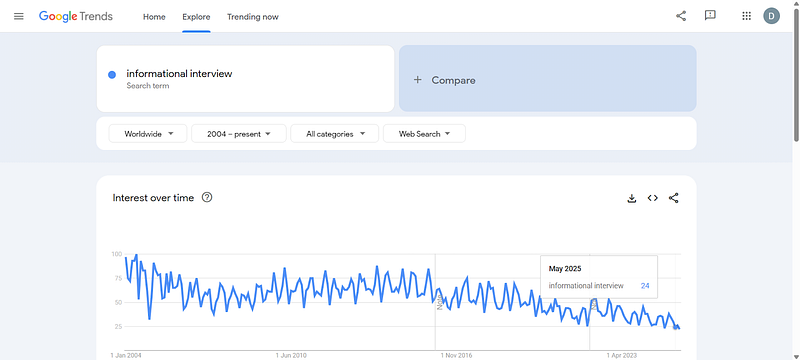
Although search trends for the term have dipped over the years, the need for informational interviews has only grown. These informal conversations give you clarity and direction.
Whether you’re changing careers, job searching, preparing for grad school, or exploring something new, talking to someone who’s been there can help you take smarter next steps.
But there’s more. Beyond just gaining insights, informational interviews help you build real, lasting professional relationships — the kind that can lead to mentorship, referrals, and community. As Lees puts it in an HBR article:
“The real purpose of informational interviews is to develop future allies, supporters, and champions.”
So how do you develop those allies and supporters?
Let’s start with the basics first. What’s an informational interview, why does it matter, and how do you conduct one with confidence?
What Is an Informational Interview?
An informational interview is an informal conversation designed to help you learn more about someone’s role, career path, organisation, or industry. While they’re often used for career exploration, informational interviews can also be valuable when you’re applying for graduate school, scholarships, or fellowships — and want insider insight from someone who’s already gone through the process.
It’s important to note that informational interviews are not job interviews, and they’re not the place to ask directly for a job. The goal is to gather information, learn from someone else’s experience, and eventually build a meaningful professional connection. That said, these conversations can sometimes lead to referrals, mentorship, sponsorship, or other career opportunities — but that’s not the point of the meeting.
It’s worth noting that there’s no single “right” format for an informational interview. These conversations often happen over a voice or video call, in person, or even through email or direct messages.
💡 If any of this sounds familiar, that’s because you might have already done an informational interview without calling it that, especially if the term wasn’t commonly used in your circles.
Why Informational Interviews Matter (Especially Before You Need Them)
There’s been a lot of buzz around informational interviews lately. Why are they so important? Why do you need to have these conversations, and how do they help you grow your network and career?
Informational interviews matter for two key reasons. They help you:
1. Gain Invaluable Insights
We’re surrounded by information. And with the rise of AI tools, it’s now easier than ever to get answers to your questions. But that abundance can also be overwhelming. How do you know which advice is credible? Which path fits your unique context? What’s actually worth applying to your situation?
That’s where informational interviews come in.
Instead of piecing things together on your own, you can speak directly with someone who has already walked the path you’re considering. You can share what you’ve learned, ask questions, and get tailored guidance, saving you time and helping you avoid common missteps.
Through these conversations, you can:
- Understand the day-to-day reality of a role
- Learn how people transitioned into a field you’re exploring
- Explore different career paths before making a big move
- Clarify your career goals and direction
- Get a better understanding of specific job roles or industries
2. Expand Your Network Organically
Yes, informational interviews provide useful insights, but they also do something equally powerful: they help you build relationships.
When you approach someone genuinely seeking to learn, you create an opportunity for connection. And if you don’t stop at that first conversation — but follow up, share your progress, ask thoughtful questions, and stay in touch — you begin to build an authentic professional relationship.
Over time, this becomes a network of people who can root for you, vouch for you, and support your career growth.
Informational interviews help you:
- Build real relationships before you need something
- Create a circle of peers, mentors, and role models
- Connect with potential advocates and sponsors
- Gain visibility and long-term support
- Discover unadvertised job opportunities (yes, most roles aren’t even posted online!)
When to Conduct Informational Interviews
Informational interviews are especially helpful when you’re:
- Considering a career change
- Applying to a company or exploring a new industry
- Preparing for grad school or a competitive fellowship/scholarship
But you don’t have to wait for a major transition to have these conversations.
Informational interviews can also be a great way to:
- Stay updated on trends in your field
- Learn from peers and senior professionals
- Satisfy your curiosity about different roles or paths
Even if you’re not actively job searching, it’s worth speaking with people in your industry or adjacent fields. You’ll gain insights, build relationships, and stay sharp, which all come in handy later.
That said, they’re especially valuable during career transitions and job searches, when clarity and connection matter most.
Who Should You Interview?
You might be tempted to start at the top. That is, speaking to C-suite executives, hiring managers, and big industry names. That’s all well and good, but those aren’t always the most accessible (or helpful) people to begin with.
Instead, start with those who aren’t too far ahead of you. Think mid-level to senior professionals, and even your peers. These individuals are:
- More likely to have time for a chat
- Closer to the challenges and decisions you’re currently navigating
- Able to offer relatable, practical advice based on recent experience
Depending on what you’re looking to achieve, here are great people to consider:
- Peers in your field (or adjacent ones)
- People in roles you want to pivot into
- Alumni of schools, fellowships, or programs you’re eyeing
- Former employees of a company you’re considering applying to
- Professionals in adjacent or less visible roles who can provide fresh perspectives
Start close. Then branch out.
Informational Interview Playbook: A Step-by-Step Guide
If you’re considering conducting informational interviews but aren’t sure where to start, this guide will walk you through every step — from identifying who to speak to, to making the ask, conducting the conversation, and following up effectively.
1. Define your Goal
Start by identifying what you hope to achieve and why. Are you exploring a new career path? Or considering a specific company or industry?
Your goal will shape who you should speak to, what questions to ask, and how to frame your request.
Don’t skip this step.
2. Identify your Target Audience
Based on your goal, think about who can best help you gain clarity.
For example, if you’re transitioning into a new role or industry, reach out to people currently working in those positions.
You don’t need to aim only for senior-level professionals. Mid-level professionals, junior employees, and even peers can provide helpful, relatable insights. Additionally, former employees of companies you’re interested in can give honest, behind-the-scenes perspectives.
💡 To help focus your outreach, create a short list of relevant job titles, experience levels, or industries.
3. Compile A List of People to Interview
Now it’s time to research and build your list. Try the following strategies:
- Search for employees at target companies (start with LinkedIn’s “People” section).
- Ask your network for warm introductions.
- If you see a mutual connection between you and someone you want to speak with, request an intro.
To stay organised, track your outreach in a spreadsheet or tool. You can use this free outreach tracker from NoCode Techies to manage your list.
4. Make the Ask
Before reaching out, do your homework. Understand their current role, previous experience, and anything else relevant. Then tailor your message accordingly.
Keep your message short and respectful, and be clear about your intentions. Another thing to keep in mind is the format. Be flexible about which format the conversation might take, as some prefer calls, while others are fine with email or text.
💡 You don’t need to say “informational interview” explicitly. Try something like: “I’d love to hear about your experience at [Company]”, or “I’m exploring a move into [Role/Industry] and would love your perspective”.
One last thing, always introduce yourself briefly and explain your goal or reason for reaching out.
Here’s a sample LinkedIn message template to try out:
Hi {First Name}, I hope you’re well. I’m exploring a {Role} career in {Industry}. I came across your profile during my research, and I’d value your insights on building a career in the field.
Get over 15 outreach message templates with best practices and tools here →
5. Prepare, but Keep it Conversational
Once someone agrees to a conversation, prepare with intention:
- Create a base list of open-ended questions
- Tailor them based on the person’s background
- Have a short intro about yourself ready: Who you are, what you do, and what you’re hoping to learn
If you didn’t research deeply before reaching out, now’s the time. Look into the person’s career path, projects, or content they’ve shared. This will help you ask smarter questions and show genuine interest.
6. During the Interview
If the interview is over text or email, you can simply send your questions and wait for responses. If it’s live (video, call, or in-person), here are a few tips:
- Let the conversation flow, but guide it with your questions
- Listen actively and take notes or record (with their permission)
- Be mindful of time and gently redirect if the conversation veers off track
- Don’t feel the need to ask every question on your list — they may answer some organically
- Start with a brief intro and end with a thank you
7. Follow Up
Send a thank-you message within 24–48 hours. In it, mention something specific you found valuable, reiterate your appreciation, and keep the door open for future communication. You can explicitly ask if it’s okay to reach out with more questions.
But don’t stop there. Stay in touch by engaging with their work online and on socials (if they’re active), sharing updates about your progress, and offering value in return (e.g. useful resources or opportunities)
💡 Building a strong network takes consistency, not just one-off conversations.
What to Ask in an Informational Interview
Your questions will vary based on your goal, the person’s experience, and your relationship to them. Still, here are some general questions you can adapt for almost any interview:

💡 Pro tips:
- Ask open-ended questions
- Avoid questions that can easily be answered by Google
- If you’re referencing online information, ask for their perspective on it
- Always circle back to your goal; let that guide your curiosity
Do Informational Interviews Lead to Jobs?
It’s helpful to approach informational interviews without the expectation of landing a job or referral right away.
Can they lead to those opportunities? Absolutely, but it’s not guaranteed.
So to avoid disappointment or putting pressure on your interviewees, go in with an open mind. The goal is simple: to gather insight and build connections. If something more comes out of it — like a job lead or a referral — that’s a bonus.
Here’s what informational interviews can lead to when done well:
- Referrals
- Visibility in hiring pipelines
- Early access to roles before they’re advertised
- Connections to mentors or sponsors
Informational interviews are a long game; they plant seeds for relationships that can grow over time. Be patient, stay curious, and see where the conversations take you.
Informational Interviews as a Gateway to Community
Throughout this blog, we’ve highlighted how informational interviews can help lay the foundation for your professional community — people who can support, guide, and root for you throughout your career.
When you don’t treat informational interviews as one-off conversations that end after the call, you begin to build a real network — a community.
Over time, that network becomes a web of insight, opportunity, and support. It can lead to visibility, mentorship, referrals, collaborations, and lasting career allies.
They become the people who fuel your growth and help you navigate the ups and downs of your career.
Don’t let this pass you by. Start building, one conversation at a time.
Next Steps: Start Now, Before You “Need” It
Informational interviews are one of the most low-pressure, high-impact tools you can use to grow your career. They help you gain insights, make meaningful connections, and stay visible in the job market.
Don’t wait until you’re actively job hunting or feeling stuck in a career transition. Start having these conversations now, when the stakes are low and the curiosity is high.
Your challenge: Schedule one informational interview in the next two weeks. It could be with a peer, someone in a role you admire, or even a former colleague working in a new industry.
Need a starting point?
Download our free list of ready-to-edit message templates (with an outreach tracker) to make your first ask easier.

 NoCode Techies